
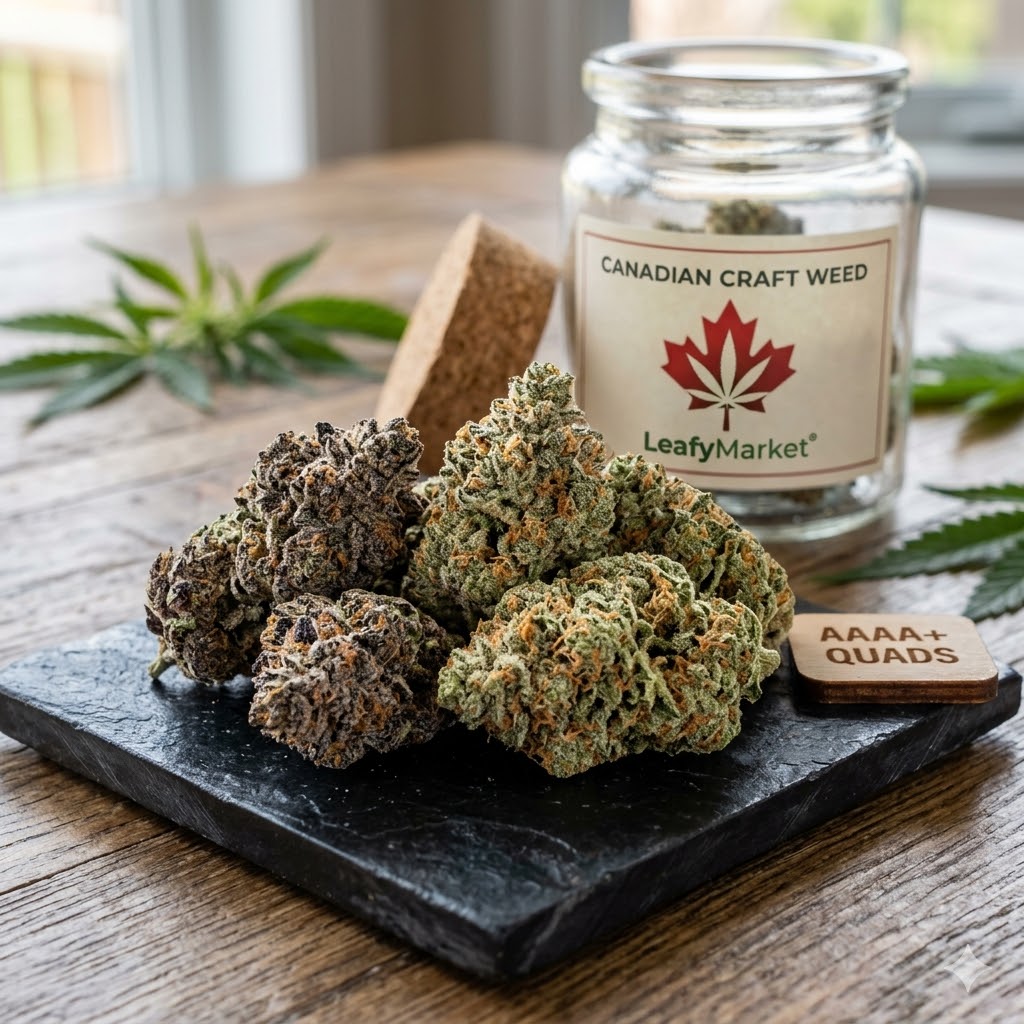
News snapshot — Eight years after legalization, Canada’s cannabis market is being quietly rewritten. The 2024 Cannabis Act review wrapped, Ontario shifted its retail rules, the federal excise tax is back on the negotiation table, the 10 mg edibles cap survived another challenge, and the U.S. DEA’s rescheduling decision is set to ripple through Canadian cross-border policy. Here’s what changed in the first half of 2026 and what’s coming next.
Filed May 26, 2026 · Industry & policy update.
Canadian Cannabis in 2026: What Changed and What’s Coming Next

The Cannabis Act review: from recommendations to action
The federal review of Canada’s Cannabis Act — launched in October 2022 under Health Minister Jean-Yves Duclos — wrapped in late 2024 with 65 recommendations across edibles potency, micro-cultivator support, medical access, and retail framework. As of May 2026, roughly half are in active implementation, the rest in committee.
The recommendations getting real action this year:
- Excise tax restructuring for small cultivators — the flat $1/gram tax has been catastrophic for small producers selling craft at $3–5/g. Expected reform: tiered tax based on producer scale.
- Micro-licensing reform — the application process is being streamlined to reduce the 18–24 month wait that has bottlenecked new entrants.
- Cannabis 4.0 framework — expanding categories beyond flower/edibles/concentrates to include emerging product types (THCA flower, novel ratios, designed cannabinoid blends).
The recommendations that aren’t moving: raising the 10 mg edibles potency cap, allowing on-site consumption lounges, federal interprovincial commerce. Each remains politically sensitive enough that no government has been willing to spend capital on the change.
The 10 mg edibles cap: still here, still controversial

Canada’s edibles potency limit — 10 mg of THC per package, regardless of serving size — has been a regulatory sore spot since edibles became legal in 2019. The Cannabis Act review heard extensive industry argument that the cap pushes experienced consumers to the gray market (where 100 mg+ edibles are routine) and disadvantages legal producers competitively.
In February 2026, the federal government declined to raise the cap, citing harm-reduction concerns about accidental high-dose ingestion. The industry response has shifted strategically: rather than fighting for higher single-package caps, producers are pushing for tiered packaging — child-resistant 100 mg multi-pack formats with stronger warning labels. That framing has more political traction than blanket cap increases and may move in late 2026.
Excise tax: the “tax cliff” finally getting addressed
The federal cannabis excise tax has been structured the same way since 2018: $1/gram (or 10% of producer price, whichever is greater). When producer prices were $8–10/gram, the math worked. As legal flower prices collapsed to $2–4/gram, the $1/gram floor turned into an effective 25–50% tax — far above tobacco’s effective rate.
The Cannabis Council of Canada estimates the current excise structure has wiped out roughly $300 million in annual industry margin since 2022. The government’s CRA division has begun aggressive collection actions against producers in tax arrears — six provincial licensed producers entered creditor protection in Q1 2026 alone, citing excise tax debt.
The expected reform, telegraphed by Finance Canada in March 2026:
- Move to a percentage-of-revenue model (likely 8–10%) instead of the per-gram floor
- Tier the tax by producer size (small cultivators under 200 kg/year may see a reduced rate)
- Apply retroactively to 2025 for producers in good standing
If implemented as proposed, the change would inject roughly $200 million in retained margin back into the legal supply chain — likely showing up as either lower retail prices or improved producer quality investment over the second half of 2026.
Provincial retail: four different paths in 2026
The provincial retail markets have diverged sharply post-legalization, and 2026 is making that divergence more visible:
| Province | Retail Model | 2026 Trend |
|---|---|---|
| Ontario | Private retail, OCS wholesale | 2,000+ stores; saturation triggering closures |
| Quebec | SQDC public monopoly | Stable; expanded edibles selection in March |
| BC | Hybrid public + private | Craft cultivator integration accelerating |
| Alberta | Private retail, AGLC wholesale | Retail expansion paused on oversupply concerns |
| Maritimes | Mixed (NS public, NB private) | Pressure on price-conscious consumers driving online sales |
Ontario’s retail saturation is the most visible 2026 trend. With over 2,000 licensed retail locations against an estimated population-appropriate count of 1,200–1,400, store closures have hit roughly 200 dispensaries in the past 18 months. Surviving operators are shifting toward craft selection, in-store budtender expertise, and loyalty programs — a maturity shift the OCS has been waiting for.
The U.S. rescheduling ripple effect
The U.S. DEA’s August 2024 rescheduling of cannabis from Schedule I to Schedule III set off a slow-rolling wave that is finally arriving in Canada. Two effects to watch:
Cross-border financial services. U.S. financial institutions have begun cautiously banking cannabis-related businesses post-rescheduling. The downstream effect for Canadian licensed producers is improved access to North American capital markets through 2026, which has driven a quiet wave of M&A among mid-tier producers — eight notable acquisitions announced in Q1 2026 alone.
Research access. Schedule III status has meaningfully expanded U.S. research capacity, which in turn benefits Canadian researchers through cross-border collaborations. Expect 2026–2027 to produce significantly more peer-reviewed cannabis pharmacology than the previous five years combined.
The craft / micro-cultivator story

Perhaps the most important 2026 development isn’t from Ottawa but from the cultivation floor. Health Canada licensed approximately 80 new micro-cultivators in the first four months of 2026 — the highest rate since the micro-class was introduced in 2018. The combination of streamlined licensing, federal tax reform, and consumer preference for craft quality has finally tipped the math.
Market share data from the OCS and Statistics Canada suggests craft cannabis now accounts for roughly 18% of legal flower sales (up from 6% in 2022), with the share concentrated among consumers spending $40+/3.5 g. The premium tier is essentially craft-dominated; large licensed producers retain the volume-and-value-tier customers but are losing the connoisseur segment outright.
What to watch through the rest of 2026
Specific things worth tracking over the next six months:
- The excise tax bill — expected late summer 2026. The structure of the final version determines whether legal cannabis can compete with the gray market on price.
- Multi-pack edibles framework — if the tiered-packaging proposal advances, expect 100 mg-equivalent packs on shelves by Q4.
- Provincial M&A — Ontario’s retail saturation is making acquisitions inevitable; expect 5–10 consolidations of independent dispensary chains in the second half of the year.
- Federal interprovincial commerce — currently illegal under section 33; the review recommended change but implementation is politically heavy. Watch for any movement in fall budget cycles.
- Pesticide and contamination enforcement — Health Canada’s inspection division has been doubling unannounced site visits since January. Expect more recalls publicly announced through summer.
The bottom line
Canadian cannabis in 2026 is in a quiet pivot. The 2018–2022 phase was about launching the market; 2023–2024 was about surviving oversupply, price collapse, and tax pain; 2025–2026 is the regulatory adjustment phase — fixing the parts of the framework that haven’t worked while keeping the parts that have. Consumers won’t see a dramatic shift overnight. But the structural changes happening behind the scenes — excise tax reform, micro-cultivator licensing, craft market share growth, U.S. cross-border financial integration — will shape what the next five years of the Canadian cannabis market look like.
Browse our craft cannabis catalog for a curated selection from Canada’s small-batch producers — many of which are direct beneficiaries of the 2026 regulatory shifts.
Legal notice. Cannabis is legal for adult use in Canada under the Cannabis Act. This article is informational and does not constitute legal or business advice. Verify specific regulatory matters with Health Canada or qualified legal counsel.
Sources: Health Canada Cannabis Act review report (2024); Statistics Canada cannabis market statistics 2024–2025; Cannabis Council of Canada industry reports 2025–2026; Finance Canada announcements on excise tax review (March 2026); U.S. DEA rescheduling final rule (August 2024); provincial cannabis regulator quarterly reports Q1 2026.